
Tortoise Beginner's Alphabet
TORTOISE ADVICE CENTRE
Land Tortoise Keeper’s Alphabet from A to Z

Here I will try to answer the most frequently asked questions about tortoises
I am a land tortoise breeder, and these are methods I have long tested and proven myself. I do not claim they are the only correct ones, and it is up to each individual whether to use them or not. It is also always necessary to take into account the specific species of land tortoise you are keeping!! I try to present everything in a way that every beginner keeper can understand, and topics are often simplified.
If you already own a tortoise that has long been accustomed to the conditions you set up, is healthy, thriving, and you are simply happy with your coexistence, I do not recommend abruptly changing everything just after reading these pages. If you decide to make changes, do so slowly and carefully. You can avoid major problems this way and better determine whether your steps are correct or not!! For the successful development of all tortoises, several principles must be met and properly combined, which is the goal of all keepers. These include diet composition, lighting and heat conditions, the quality and duration of hibernation (if it is a species that requires it), humidity, and the housing enclosure.
Table of Contents / Questions:
1. What species of tortoise should I get?
2. We brought the tortoise home – what’s next?
3. What should I feed a land tortoise?
4. What substrate should I use in the terrarium?
5. What lighting and temperatures should I use in the terrarium?
6. What accessories do I need for the terrarium?
7. How and should I hibernate my tortoise?
8. How to wake up (de-hibernate) a tortoise?
9. What terrarium or enclosure size and type should I choose?
10. Should I carry the tortoise outside and back into the terrarium?
11. What documents do I need upon purchase and what do they mean?
12. How do I recognize a sick tortoise?
13. How do I recognize and determine sex?
14. How and where to register a tortoise at the office?
15. When and how often should I clean the terrarium?
16. What to watch out for when purchasing accessories and equipment?
17. Myth and superstition regarding South African tortoises
18. Flies and other pests in the terrarium
19. Ant nests in the tortoise enclosure
Like any living creature including humans, dogs, elephants...... a tortoise also needs certain conditions for life; if it lacks them, it eventually becomes a tragedy for both the tortoise and the owner!! Therefore, carefully consider getting a tortoise and weigh your options, because keeping one properly requires your time, love, and finances.
Surely all of you, like me, know that even when our breeding conditions are set to a recommended optimum, it may not always suit the tortoise at that exact moment. Conditions are adjusted continuously based on the tortoise’s behavior using a keeper’s intuition. For example, in spring when a tortoise starts becoming apathetic, temperatures are lowered......... Everything simply cannot be crammed into tables or instructions, and every individual requires a personal approach from the keeper. So a 100% manual on how to keep a land tortoise does not exist; unfortunately, that is how it was, is, and always will be. author: Miloš Junek
1. What species of tortoise should I get?
Beginner:
I am a beginner keeper determined to keep land tortoises and trying to figure out which species is best suited for me? For everyone who knows nothing about tortoises, I recommend choosing one of the 4 commonly available European tortoise species where juvenile prices mostly do not exceed 2,000 CZK. It must be noted that these species require the same care, environment, lighting conditions, and diet, with only minor and essentially negligible changes or enclosure adjustments for that specific species...... so that is not how you make your choice :-)). One of the most important things is what kind of enclosure or terrarium we are able to provide for the adult tortoise, and that is where it gets real.
"Don’t leave your choice to chance. The foundation of success is a vital hatchling from a reliable breeder. You will save yourself paperwork hassles and have the certainty that the tortoise is healthy and properly feeding. Plus, if you purchase a complete terrarium with your tortoise, you get a 200 CZK discount."
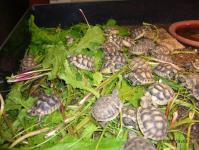
Land Tortoise Hatchlings
- Healthy and feeding hatchlings
- Includes necessary documents
- Beginner guidance included
from 1,990 CZK
Current OfferIf we have a house or apartment with a garden or a sufficiently large balcony and are willing to share space with the tortoise, the choice is purely a matter of taste. If we only have an apartment, and a smaller one at that, we should also care about the adult size and their space requirements. Here I will describe the species and their sizes (noting these are common and average, and of course there are individuals that deviate from the average due to: subspecies groups, specific localities where they live, and special conditions created by man or nature and geographic region). Clicking on the name will show you an adult individual—a female. In these species, males are usually of smaller or equal stature. We will be talking about adult tortoises that are hibernated and kept all summer in an outdoor enclosure; it is naturally different for individuals kept in terrariums where the active period is much longer and, if they do not hibernate, they reach adulthood earlier.
Testudo hermanni - Hermann’s tortoise:
grows to a usual size of 15 - 25 cm, and males 15 - 20 cm depending on the subspecies and form; outdoor activity of hibernated tortoises is 5 - 6 months trouble-free depending on the environment. An adult female lays an average of 3 - 8 eggs in two clutches. Smaller subspecies Testudo hermanni hermanni reaches 13 - 17 cm. More about this species in a separate article: TESTUDO HERMANNI - HUSBANDRY
Testudo graeca - Spur-thighed tortoise:
grows similarly to Hermann’s at 20 - 25 cm, and males 15 - 20 cm; outdoor activity of hibernated tortoises is 5 - 6 months trouble-free, only tortoises kept outdoors year-round occasionally catch a cold, which is left untreated and subsides on its own 99% of the time. Out of these tortoises, they tolerate frequent changes of housing and conditions the worst. An adult female lays an average of 3 - 6 eggs in two clutches. More about this species in a separate article: TESTUDO GRAECA - HUSBANDRY
Testudo marginata - Marginated tortoise:
mostly grows to 25 - 35 cm depending on subspecies and form. Males of this species are equally large; trouble-free outdoor activity of hibernated tortoises is 5 - 6 months. An adult female lays an average of 6 - 13 eggs in two clutches. More about this species in a separate article: TESTUDO MARGINATA - HUSBANDRY
Testudo horsfieldii - Russian (Four-toed) tortoise:
grows to a size of 18 - 23 cm, and males 15 - 20 cm. I do not keep this species myself, so I use available background materials from a friend who keeps them. It is the species active for the shortest period in the year; outdoor activity of hibernated tortoises is 3 - 5 months, and males are characterized by a rather aggressive behavioral pattern toward females, which is given by the species and its specifics, though that does not change the fact that females are often severely bitten, mainly on their legs. A disadvantage of this species is that they can burrow so thoroughly that we only find them in spring and must hope they survive. With this species, one must be careful about imported animals traded actively since they do not need an exemption from commercial activity bans, and adaptation to new conditions when importing without health problems is not always successful. More about this species in a separate article: TESTUDO HORSFIELDII - HUSBANDRY
Advanced:
If we feel financially and professionally ready, we can dive into the second group where juvenile prices range from 3,000 to 6,000 CZK. We can start with the largest tortoise.
this is a very frequently offered tortoise that grows to an adult size of 40 - 55 cm, and up to 70 cm in extreme cases, which we must count on from the start. No one can tell you, apart from certain presumptions, whether your particular piece will be a record breaker. It is a trouble-free tortoise that can spend even the 4 warmest months in an outdoor enclosure without any problems in our latitudes. The only thing to count on is the necessity of an indoor heated enclosure during the other months, requiring a minimum of 1.5 x 1.5 m for 1 adult, which is sometimes a problem. With juveniles we acquire, we avoid imported animals and focus on breeders who truly breed this species. This also avoids potential health problems that threaten imports much more, as this species is frequently imported. More about this species in a separate article: GEOCHELONE PARDALIS - HUSBANDRY
Geochelone elegans - Star tortoise:
it is one of the most beautiful tortoises where females grow to a size of 20 - 25 up to 30 cm, and males are drastically smaller at around 14 - 18 cm depending on the subspecies and locality they originate from. If this tortoise is kept year-round in a terrarium, which is probably the most suitable environment for it, or other spaces adapted for this species, everything is fine. However, it is one of the most sensitive species where a draft or unsuitable conditions, including a poorly designed outdoor enclosure, will spell trouble. The shelter house must be tempered to at least 20°C; otherwise, endless problems quickly begin, mainly with runny noses, pneumonia, and weight loss.... and we rarely avoid professional treatment including antibiotics, and the outcome is always extremely uncertain and stressful for the keeper. In my opinion, this species clings much more to its environment than others, and once content, it is unwise to change anything. An adult female lays an average of 3 - 8 up to 10 eggs in two clutches. More about this species in a separate article: GEOCHELONE ELEGANS - HUSBANDRY
Malacochersus tornieri - Pancake tortoise:
unlike others, this tortoise is flat in profile, grows to a size of around 15 - 18 cm, and is characterized mainly by excellent climbing abilities; it is equipped for this, and a person sometimes shakes their head in disbelief at the obstacles it can overcome. Therefore, when building an enclosure, attention must be paid to fencing, which should be sufficiently high, yet smooth so the tortoise cannot get a grip, otherwise it climbs vertical walls with ease. Regarding husbandry, it is generally a trouble-free animal that can spend the 3 - 4 warmest months in an outdoor enclosure where the indoor shelter house must be maintained at a min. temperature of 13 - 15°C. Most of the daytime is spent hidden in a crevice; they make very little use of open-area sunbathing and emerge primarily for food. Rocky obstacles and shelters of various sizes formed mostly by stones suit them well in the enclosure. There are no problems with breeding, and an adult female lays an average of 1 - 2 eggs in three clutches. In a breeding group, two adult males mostly do not tolerate each other and fierce fights for a privileged position occur. More about this species in a separate article: MALACOCHERSUS TORNIERI - HUSBANDRY
Breeders and crazy enthusiasts:
These two categories are quite close even if they don’t look like it at first glance. In this category, we are talking about true gems from the world of land tortoises, more or less financially and physically accessible, where prices for juveniles start around 10,000 CZK and climb to staggering heights depending on the species!! Here it is no longer worth describing breeding conditions....... anyone who wants to jump into this should first study as much material as possible about the acquired tortoise and prepare accordingly starting with the enclosure... These tortoises include individuals of species such as:
More about this species in a separate article: GEOCHELONE RADIATA - HUSBANDRY
More about this species in a separate article: GEOCHELONE SULCATA - HUSBANDRY
More about this species in a separate article: MY LECTURE AT ZOO PRAGUE
More about this species in a separate article: CHERSINA ANGULATA - HUSBANDRY
Homopus signatus, Geochelone platynota and many other species.
Conclusion:
It must be known that everything discussed here concerns tortoises I know or keep and can speak about personally, and it seems pointless to copy information here that is abundant on the internet, and I doubt anyone likes reading multi-page descriptions. These are mostly the most commonly kept tortoises of standard dimensions, and it is always necessary to remember that everything evolves from and depends on breeding conditions and their overall combination; that is where every breeding effort begins and ends, and it is the alpha and omega of keeping not just tortoises, but all animals. By keeping the most common group of tortoises recommended for beginners, we can test for still acceptable money whether we enjoy it, and if so, we can move on to the next level in time—like people who know what it’s about—though of course we can skip the first, but in case of failure it will hurt more, and not just financially. I deliberately do not go into absolute details for each species and try to provide basic orientation grounded primarily in my experience, successes, or failures.
Choosing the tortoise species for your conditions:
Here we do not discuss what a tortoise "can endure" or how it can adapt, but how each species is suited for the intended method of keeping. The further you are from natural conditions, the more the tortoise actually suffers without the keeper realizing it. Through this simple comparison with the conditions you intend to set up and how you will keep it, you will arrive at species that suit you more or less. In your case, following this simple formula will lead you to a choice.......... This is not my opinion on something, but bare facts that some might dislike and even deny, but no one can deny the widening scissors effect. Therefore, every keeper should strive to keep that widening as minimal as possible.
If one cannot achieve this even approximately by the nature of their options, problems are on the horizon and they can forget about the tortoise’s long-term lifespan in advance. The compromise then is choosing the species that best fits their conditions. That says it all, and that is why someone might wonder why I recommended this to one person and that to another; I am always interested, if the customer cares, in how they will keep the tortoise and their keeping conditions, and based on that I recommend the most suitable species from the offer. There are species of land tortoises that are suitable directly for year-round terrarium keeping, but I doubt anyone intends to spend 15,000 CZK or more on a new pet, so the choice shrinks to the most common—meaning European—tortoise species, both in terms of availability and price.
You can learn more in separate articles here:
Which land tortoise species to get
A tortoise for a small apartment
! Important:
Since small tortoises are mostly sold year-round, do not forget to ask the breeder or seller what period we should simulate for the tortoise after purchase. This will avoid complications with an inappropriately set environment, especially temperature-wise! Problems adapting to your new environment are then much easier, and the tortoise is not totally disoriented. For tortoises sold by me, you can find the conditions they have been kept in since hatching here: Breeding conditions of tortoise hatchlings
MORE IN A SEPARATE ARTICLE:
Which tortoise species to choose
2. We brought the tortoise home – what’s next?
Transport:
It is generally best to transport them in a small box, preferably with a lid and opaque. On the bottom, we place e.g., newspapers, substrate, shredded meadow mix, hay........ Various fabrics are unsuitable because small hatchlings have very sharp claws and get caught in the fabric, which can cause injury. If the tortoise has no light and heat, it will sleep through most of the trip and it is not advisable to handle it too much, because like for anyone, it is a certain stress that is unnecessary to increase. In the car, we place it away from heat sources like heaters, direct sun... to prevent overheating.
We are home:
I assume that spaces for the tortoise are mostly prepared in advance, so we turn on all lighting and place the tortoise in the coldest part of the terrarium. The tortoise will then determine for itself which temperature suits it at the moment. The first hours of stay in the new environment will be spent intensively mapping and exploring the new surroundings, and it is good to have food and water ready from the beginning at the spot where we will be serving it. Unfortunately, a tortoise is not a dog and gets used to a new environment much longer, and it can happen that it burrows and ignores everything for a certain period. What needs to be monitored are recommended temperatures because if the tortoise doesn’t have them, it is passive. If we want it to be active even in the late afternoon hours when children are mainly home, we adjust the start of lighting later to morning hours around 10 - 11 AM. By doing this, we shift the tortoise’s day:-))
Conclusion:
With small tortoises, it usually takes the first half-year before they reach full activity and begin feeding heartily and growing. It is important to note that even in individuals of the same species and age, this period does not have to be identical and in extreme cases can even be contradictory.
3. What should I feed a land tortoise?
In summer:
Meadow mix, dandelion leaves and flowers are especially suitable and liked, hibiscus flowers, clover, plantain….... Exclude oxalates (sorrel, etc.) as they bind calcium in the tortoise’s organism. Aromatic herbs from the garden such as: thyme, agrimony, marigold, lemon balm, lavender, rosemary, goat’s rue, oregano......... You can give them this occasionally for taste, but they probably won’t gorge on it because they don’t really like aromatic herbs. Thus, it is not suitable for long-term nutrition and you can offer it only to liven up the diet. Beware of vegetables like kohlrabi, cabbage, cauliflower, beets, lettuce...... these plants contain excessive amounts of nitrates and are therefore unsuitable in the long run.
Tortoises need food rich in calcium (calcium-phosphorus ratio 3:1) and fiber.
Dandelion (100 g) - energy 188 kJ, fiber 3.5 g, calcium 187 mg, phosphorus 66 mg
Lettuce (100 g) - energy 54 kJ, fiber 1 g, calcium 32 mg, phosphorus 23 mg
Does anyone still feel that lettuce is a suitable food?
In winter:
Chinese cabbage as a base; you can also try carrots. Lamb’s lettuce, arugula, and salad chicory (endive) from the market, where it is best to mix them into the cabbage 1x a week to vary the diet. You can also try quality hay, but in my experience, tortoises accustomed to green food eat it only after several days of fasting. For a sufficient calcium supply, sprinkle food with calcium carbonate 2 - 3x a week (calcium carbonicum); you cannot overdose the tortoise, and it can be purchased in my e-shop (Vitacalcin tablets contain the same substance – but you must crush them, and they are not suitable for long-term use due to additives), or you can grate a cuttlebone, or place a whole one in the terrarium, though then calcium intake is not guaranteed because some tortoises ignore it while others adore it—you must try it! When calcium is supplied this way, it is forbidden to additionally give synthetic (artificial) vitamin D. If you artificially supply D to the tortoise, it leads to its increased absorption and subsequent deposition of calcium mainly in large active muscles including the heart!! If it gets D from a UV lamp or sunshine, everything is problem-free, the tortoise regulates and doses everything itself (even the calcium you add), and that is how it should be and nothing threatens it:-))
Fruit:
Minimally, just for taste; suitable apples, strawberries, plums. In my view, 1x a month—max 1x a week—a small piece with food as a treat. I absolutely do not recommend various exotic fruits, citrus fruits, especially tomatoes, as they bind calcium (so important for the tortoise) and thereby promote its decalcification!!! Realize that in nature they encounter fruit during the year only provided it ripens and falls from the tree, and they must also be lucky enough to occur in that locality or nearby. So very sparingly or not at all.
I managed to find a table of calcium and phosphorus content in plants and fruits. However, some are unsuitable or inedible for tortoises despite their calcium content. Take this only as informational material!

Pellets:
My opinion on pellets: the only thing I am willing to accept is pressed granulated hay, and otherwise if you can, avoid them. Generally, people are somehow manipulated by advertising for dog food, words like - the best food in the world - nothing better you can do for your pet, etc. The truth is the opposite; ask any top breeder of purebred dogs for their opinion, and of course even a dog would rather have meat than pellets. And how about looking at it differently: which of you would eat human pellets with the awareness that you are eating the best? Probably only a few individuals. The production of these products is focused mainly on making them tasty for animals, disregarding added colorings, stabilizers, binders..... they are not subject to strict rules and long-term research. Promotional videos seen on the internet of tortoises being fed pellets are pure manipulation by sellers, and it must be kept in mind that what tastes good does not mean it is healthy.
Most problems only appear over the long term in a horizon of several years (10 and more), when remediation is mostly too late, and all this is just the tax for a certain convenience where you just reach into a box and feeding is done. Pellets, like practically everything nowadays, are just ordinary business, and whoever is serious about tortoises will provide everything in the form of natural food, which is absolutely the best thing you can do. If someone decides to use them, the best are single-colored ones designed for land tortoises, pre-soaked, and not left in the terrarium for longer than 24 hours (they mold quickly)! Pellets increase in volume and bind water, making dry ones unsuitable for tortoises. Combine with natural food as much as possible! Of course, as always, it depends solely on you what you provide and how long it will live happily here with you.
2015: for the last few years, I have started practicing adding pellets to the diet of small tortoises during the winter period, and only 1x a week! The pellets are custom-made for land tortoises, mainly due to the poorer diet during the winter period. Small tortoises grow very quickly, and in the first phase, pellets should supplement any deficit of necessary substances for successful growth.
Calcium:
CALCII CARBONAS - calcium carbonate I have used long-term for all tortoises, and it is the idea of my clever wife, who years ago suggested this simple and effective way to ensure tortoises get this very important component. Lightly dust the food, depending on the land tortoise species 3 - 7x a week, and I have only the best results with it. Today, this "invention" of ours is starting to be promoted by competitors as well, which will mainly benefit all tortoises.
One keeper’s experience with lettuce:
Hello. Following your advice, I went to the vet and did well. The little tortoise was poisoned by lettuce, which it loves, supposedly. It got 2 injections, we keep it heated 24 hours a day to speed up metabolism, and yesterday it already opened its eyes and started eating. I didn’t notice it at all, but the doctor warned me that it changed color, that it is blue-black, that it is suffocating. Now it’s okay, I shouldn’t give lettuce, cucumbers, tomatoes........ So I bought new pellets, vitamins, cuttlebone (it doesn’t want to eat it) and hopefully it will grow some more. Thank you xxxxxxxxx
Conclusion:
NO SPONGES (BISCUITS), MEAT, COTTAGE CHEESE, EGGS, ROLLS........ AND KITCHEN SCRAPS ARE SUITABLE FOR DIET. I AM NOT SAYING THE TORTOISE WON’T EAT IT, BUT IT IS UNHEALTHY AND OFTEN EVEN DEADLY FOR IT!!!!! A TORTOISE’S ORGANISM CANNOT PROCESS LARGE AMOUNTS OF ANIMAL PROTEIN!!! WHEN YOU DECIDE TO GIVE SOMETHING UNHEALTHY, DO IT OCCASIONALLY FOR TASTE AND UNDER NO CIRCUMSTANCES REPEATEDLY AND CONSTANTLY!!!
I DO NOT RECOMMEND: artificially giving vitamin D to tortoises unless you are an expert in the given issue!!!!! Really avoid it; you will mostly do more harm than good. You can find something extra in the article: PRINCIPLES OF LAND TORTOISE KEEPING
Further details on diet and its storage can be found in the article: TORTOISE DIET
Various questions about tortoise diet often come to my email, and this one can serve as a good example:
Question:
Hello. Your website seems the most knowledgeable on the internet, so I would like to ask you—we recently bought a small Hermann’s and need advice on winter diet. Do you think it is possible to try growing dandelions and similar things at home during the winter? Of course, I know about Chinese cabbage, but I don’t want to feed our little tortoise just the same single thing all winter. I also read that they enjoy winter cactus etc., but I would like to hear your opinion... Thank you very much for any advice, sincerely xxxxxx
My answer:
You can grow dandelions of course, and it is suitable; no one can have anything against that. It’s only good for the tortoises, but regarding feeding cactus and other unknown plants? Here one must be very careful; there are many species, and people often think that if a tortoise eats it, it’s good for it, which is a complete misconception in this regard. On the internet you can then find instructions on proven feeding herbs, plants..... but what they contain and how suitable they are for tortoises is practically unknown to anyone, and the main indicator is usually how much the tortoises like this or that. I also like smoked meat, and it certainly isn’t healthy, especially with frequent consumption.
I don’t know the composition of this cactus, and it could easily be toxic to tortoises, so it is better to stick to the rule: if I don’t know the composition, feed only occasionally or better yet, not at all! Tortoises are very conservative in everything including diet and need to consume foods where the phosphorus - calcium ratio is ideal....... and Chinese cabbage, endive, and chicory from foods obtainable in the winter period clearly fulfill this. Therefore, it is good to stick to feeding whose composition is primarily known and recommended by specialists and professional literature, and which is suitable and healthy. Better than risking potential health problems for the tortoise. A bad and inappropriately chosen diet usually shows on the tortoise only after a while, which can confuse us, and always keep this in mind.
Whenever you are figuring out what new and tasty to give your tortoise to eat again, remember this:
Why feed a land tortoise something it doesn’t have in nature!!
The answer is very simple - the tortoise simply doesn’t need it and it often harms it!!
4. What substrate should I use in the terrarium?
Motto:
The task of us keepers is not to invent new, amazing, and super-modern substrates, but to try to imitate as closely as possible the conditions in which the tortoise lives in nature. And that’s what it’s all about. Miloš Junek
Substrate:
Best on 1/3 of the terrarium are pebbles/stones - NOT sharp gravel. Or flat stones. The rest is coconut fiber; you can buy everything in my e-shop, prepare according to instructions, and mix in 4 liters of dug sand (a possible alternative instead of soil). Keep the substrate moist, especially with young tortoises. At night, it is suitable to mist the terrarium with a houseplant mister. The tortoise can thus naturally choose between dry and humid, which is important. Instead of substrate, ordinary soil can be used (beware of purchased soil and fertilized locations when gathering soil in the garden or nature), which is the best and above all most natural base for the tortoise. It is suitable and you can mix it with sand if you don’t mind a dirty tortoise, and if the terrarium is dirty too, there’s nothing to solve (of course, don’t forget to combine with stones.....).
Lignocel - coconut fiber:
Mixed with sand, sometimes also with soil, I have used it for more than 15 years with all tortoise species. So far, not a single one has died from ingesting Lignocel, and since I personally autopsy every tortoise, I know what I am talking about. This can already be considered a benchmark as long-term research, and the probability of this problem occurring is currently very low. If this ever happens, it is in my opinion a problem where Lignocel accumulates in the digestive tract only after a blockage from another cause. So it is merely a subsequent problem. Most people who write about it have not verified it, and it is often rumors or distorted facts.
Recently, a certain young lady wrote to the forum that her tortoise ate Lignocel, is vomiting........ X-rays showed nothing, and a subsequent surgery on the tortoise at a clinic in Brno shed light on the mystery. It was discovered that it had a bone stuck in its intestine and as a result, sand and stones had accumulated around it—things it can normally get rid of in nature. Of Lignocel, naturally not a trace. That’s just it; whoever read it passed it on, and the result is clear - Lignocel is to blame, whereas the opposite is true! Unfortunately, that is how it is in most cases.
Of course, it is entirely up to each individual how they approach this, but for myself I can say I will definitely not change anything. Lots of people who keep them on wood shavings cannot get used to the tortoises being dirty........ are you really sure that bothers the tortoises? It is always necessary to combine multiple surfaces. In nature and the garden, a tortoise normally burrows into soil, and it certainly doesn’t mind. How to prepare the substrate in the article here:
Preparing substrate in the terrarium for tortoises
I do not recommend:
Wood shavings so frequently used today, cat litter..... Fundamentally, these are not natural environments. Someone might object that the tortoise is doing well, growing, eating.... That is indeed true, but the question is what choice does it have? It only tries to survive in the environment it has, which is natural for any creature including humans, but the consequences. Damp wood shavings quickly mold, compact, maintenance of spaces is made very difficult due to old food and waste getting mixed into the bedding, thus significantly complicating collection. Last but not least, on soft footing there is no natural wearing down of claws at all.
Conclusion:
It is always best to picture the tortoise in nature and try to bring its environment at your place as close as possible to the conditions it has there. I consider it appropriate to combine various terrains and thus give the tortoise a choice. Of course, everything according to the keeper’s possibilities, and believe that it will thank you for it:-)). I recorded several negative responses regarding my opinion on WOOD SHAVINGS, and since even I am not always 100% sure and sometimes work based on judgment, I wrote to the Clinic of Avian, Reptile, and Small Mammal Diseases in Brno to the head of the department: prof. MVDr. Zdeněk Knotek, CSc, who is a specialist and recognized expert, and asked him for his professional impartial opinion on this issue, and with his consent I publish his complete answer here:
Dear Mr. Junek,
When it comes to bedding or more precisely substrate in the terrarium, it will always be a compromise. If tortoises are kept in outdoor enclosures, gardens, there is usually no problem. However, a terrarium is always small and the concentration of risks is high. Sawdust is completely unsuitable. Likewise, wood shavings (although this substrate has been used by some terrarium keepers for decades) cannot be recommended. If wood shavings are moistened and warmed, which is completely common in terrariums, they become an excellent substrate for bacteria, yeasts, and molds. The consequences in snake breeding are generally known – respiratory infections and chronic dermatitis. Tortoises are not immune to this risk either. Moreover, there is a risk of targeted or accidental ingestion of wood shavings – the result is obstipation of a section of the digestive tract (furthermore difficult to diagnose by common imaging methods). Some wood shavings can release toxic aromatic substances (for example terpenes). Specialized veterinary literature is unequivocally against the use of sawdust and wood shavings in terrariums.
A minimal risk and conversely quite a suitable base for tortoises in the terrarium is represented by high-quality dried hay. It fulfills all functions of hygienic substrate (bedding), and if ingested by tortoises, all the better. The volume of fiber is totiž an important factor in tortoise diet.
Sincerely,
Prof. MVDr. Zdeněk Knotek, CSc., Dip ECZM (herpetology) *,**
Clinic of Avian, Reptile, and Small Mammal Diseases
Faculty of Veterinary Medicine
University of Veterinary and Pharmaceutical Sciences Brno
and
**Klinik für Geflügel, Ziervögel, Reptilien und Fische
University of Veterinary Medicine Vienna
There is nothing more to add; hopefully I managed to convince at least someone of the unsuitability of this base:-))) I thank the Mr. Professor for his expert standpoint.
Unfortunately, this is how it can sometimes turn out! This concerned a tortoise that the owner kept on a substrate of wood shavings, and suddenly out of nowhere the tortoise began having the described problems.

5. What lighting and temperatures should I use in the terrarium?
Lighting and temperatures:
"If you want to save yourself the hassle of choosing and complicated compatibility calculations for lights, I have prepared a complete set for terrariums 60 cm in length, where you have absolutely everything needed right from the start:"

Terrarium Set 60
- All 3 types of lights
- Substrate and vitamins
- For 60 cm terrariums
1,829 CZK
Set detailsDaylight simulation - ordinary white fluorescent tube or screw-in energy-saving bulb 10 - 12 hours daily, and you need to make sure they are of the white spectrum! For localized heating, place a spotlight bulb for warming up in the corner of the terrarium, with the temperature measured on the substrate under the lamp at 40 - 45°C, turned on 10 hours daily (whoever has doubts can put a thermometer outside in the sun during summer) to simulate the summer period. It is advisable to place the spotlight on one side of the terrarium to maintain a lower temperature on the other side, which serves as a cooling-down zone. Ideal temperature in the terrarium 25 - 28°C (summer period). The spotlight also serves as a heater, and one should start with e.g. 25 W and gradually, if it doesn’t heat up enough, buy a stronger one and adjust those 40 - 45°C (summer temperatures) by raising it above the substrate.
If the tortoise does not have year-round access to sunshine, it is necessary to provide essential UVA and UVB via special metal halide lamps, fluorescent tubes, etc., so the tortoise can synthesize vitamin D. This vitamin is essential for calcium and phosphorus metabolism – in its deficiency, bones soften and rickets (shell deformation) occurs. Juveniles are affected the most: Osram Ultravitalux 300W and other quality discharge lamps; links can be found on the home page bottom left and measurements at: http://www.euzelva.cz/clanky/zelvy-mereni-zdroju-uv-uvod.html. When choosing, the heating effect of the lamps must be considered to prevent overall overheating of the terrarium. With a quality UV lamp, one hour of lighting per day is sufficient, and the lighting period can be split into a morning and afternoon cycle; if you have a sufficiently large terrarium, you can of course light longer, which is best.
Conversely, compact sources are lit for the entire lighting duration. Overnight, the greatest possible temperature drop is desirable (depending on the land tortoise species) easily down to 15°C, and of course all lighting and heating are turned off. When simulating a period other than summer, we gradually lower temperatures by up to 5°C, even under the light source.

Conclusion:
Providing UV radiation (sunshine or a UV lamp) is thus a fundamental factor, essential for the good growth and development of reptiles. Vitamin D can indeed be supplied in the form of dietary supplements artificially (synthetically), but this method is harder to control even for experienced keepers, and overdosing also causes bone softening, kidney disease, up to death, and furthermore with this method the aforementioned addition of calcium is forbidden!! It must always be kept in mind that overheating is more harmful than the opposite!! If temperatures do not suit the tortoise (in the active period), it is mostly burrowed and waiting for more suitable conditions. Inappropriate temperature is one of the most frequent mistakes of beginner tortoise keepers.
Simplified:
VITAMIN D:
1) when you supply vitamin D via sunshine or a UV lamp, which is best, you can add calcium as much as you like!
2) when synthetically, which is not recommended at all, then adding calcium is forbidden!
UV SOURCES:
fixtures of the fluorescent tube type are not capable of producing quality UV radiation suitable for tortoises, and when they do, only at a very close distance! If you are looking for quality, look for discharge lamp types! If someone offers you a bulb for 130 CZK as UV, it’s nonsense, and even quality fluorescent tubes are mostly priced above 400 CZK! But if you already bought some special fluorescent tube, it is advisable to place it at a distance of max. 5 - 10 cm from the tortoise; only thus can you guarantee at least some negligible effect and utilize its potential. Separate article:
One exemplary instance of disinformation spreading for all
Question:
Greetings.
Miloš, have you ever encountered a similar case?
I quote:
You can dust with calcium, but you must supply D3 at the same time. Otherwise, it’s trouble. Calcium is not processed, but deposits outside bones in organs as well, and death eventually occurs. The autopsy result is then an extensive amount of calcium deposits in bones, but mainly also in the liver and kidneys.
Thanks, Jarda
Answer:
This is complete nonsense! If you supply calcium to the tortoise, you don’t have to worry about anything at all, provided that the tortoise’s organism produces vitamin D itself based on UVB radiation, and it doesn’t matter whether it will be the sun or a special UVB lamp. However, BEWARE, if you synthetically supply D3 e.g. in drops, YOU MUST NOT ARTIFICIALLY ADD CALCIUM!!!!!! That’s when trouble threatens with calcium deposition throughout the organism, and these tortoises are called "stone tortoises" among keepers.
So if someone wrote what you describe, it is complete breeding "bullsh*t" because they recommend the exact opposite, meaning they actually incite the targeted killing of tortoises! If they spread such opinions on the internet, they support increased mortality of all land tortoises.
I apologize for harsher expressions, but in this case it is fully in place.
Miloš
Further information on UV sources and measurement in separate articles:
MEASUREMENT OF UV RADIATION SOURCES
Husbandry accessories: E-shop Everything for Tortoises
Maximum temperatures and placement of lighting in the terrarium

It is always better to shine the spotlight and UV lighting onto the substrate rather than stones......!!
Temperatures for European tortoises in the terrarium for the summer period:
Testudo hermanni, marginata, graeca
8:00 AM lighting start, temperature in the terrarium in both parts depending on environment 18 - 22°C
1:00 PM everything is running, gradual temperature rise:
- spotlight in the center of heat on the substrate 40 - 45°C, temperature held all day
- cool part around 25°C, temperature gradually rises until evening
6:00 PM hours just before turning off all lighting, in the cool part max. up to 28°C
7:00 PM - 8:00 AM night mode, everything is off, temperature drops gradually until morning towards 20°C
Above all, we must not forget that during purely terrarium keeping, we cannot maintain the recommended (summer) temperatures all year round. Roughly every 3 months, if possible, we change the temperature rhythm including lighting duration and try to adapt at least distantly temperature-wise to the season we want to simulate. If we do not follow this, land tortoises will be overheated for a long time or conversely under-heated, and the tortoise can get into health problems or even die!!
Description:
I tried to describe how temperatures in the terrarium work here, intended mainly for beginners. We always measure on the substrate and it is important to know what species of tortoise we keep and what period we are simulating. What is described applies to European tortoises for which we simulate summer weather in the given period. Temperatures can vary slightly, and in a really large terrarium of length approx. above 1m, they can easily be lower in the cool zone with a gradual transition all the way under the lamp to the mentioned maximum of 23 - 28 - 45°C. Temperatures can be regulated according to the wattage of lighting (used for lighting and heating). Or in open aquariums by partially covering the upper part. Whoever thinks temperatures are high must realize that temperatures in Greece, Bulgaria.... where tortoises live reach well over 30°C in the shade during summer, and in the sun it is easily well over 50°C and at night around 22°C! We do not approach these temperatures by any stretch, but we cannot be too low either. During the day, therefore, we cannot have 20°C in the cool part if we simulate summer weather!! That is far below the summer norm. Something extra in the article:
TORTOISE CONDITION AND SEASONS
MEASURING TEMPERATURES IN TORTOISES
6. What accessories do I need for the terrarium?
Accessories:
Water bowl, and it is advisable to insert a flat stone on the bottom for easier exit and entry of the tortoise from the bowl. Water depth at most up to the tortoise’s beak, clean as needed. Food bowl for easier maintenance. Suitable rock formations and flat stones placed at an angle, tree bark....... all serving as a shelter, taking animal safety into account and placed in the colder part of the terrarium. A hygrometer and thermometer should also be part of the equipment for better overview.
Conclusion:
A heating stone is a mistake, highly unsuitable for tortoises and recommended by no reptile expert!! Also beware of placing obstacles near and under the spotlight where it is quite hot, and if your tortoise flips onto its back in this spot and fails to right itself within a relatively short time, death often occurs due to overheating.
Husbandry accessories: E-shop Everything for Tortoises
7. How and should I hibernate?
Hibernating juveniles:
Conclusion:
The rule applies: if you don’t feel confident about hibernation, rather avoid it; a major mistake means its end, as the tortoise does not unconditionally need it for life. Mostly during the year it compensates for missing hibernation with reduced activity, e.g., in the outdoor enclosure. If it nevertheless happens that your tortoise hibernates by itself in the terrarium, turn off all lighting and let it rest until it shows activity again, and don’t forget to monitor substrate humidity! One must always be on guard whether it is some illness and not confuse it with hibernation!! These are all my tested findings and procedures, and I do not force them on anyone. They work for me, but you can certainly apply other guides of various keepers; mostly they all lead to a successful goal.
Hibernation risks and comparison:
Before you decide to hibernate, you must also know what risks you are taking, and therefore I have prepared a simple comparison of a tortoise kept at home and one from nature. Mainly tortoises kept in home conditions are mostly poorly hardened. Everyone will certainly realize the potential risks we take themselves. It doesn’t matter how many times the tortoise has already hibernated; at the beginning of autumn, they all stand at the imaginary starting line in different condition, and what applied last year may not apply this year. In nature it doesn’t matter, the weaker one dies and life goes on.
Home Nature
1. spoiled tortoises, temperatures, diet...... much more resilient, hardened........
2. tortoises, we always want to wake up natural selection, weaker ones die
3. inappropriate preparation for hibernation long-term, gradual, trouble-free
4. inappropriate temperature in winter quarters ideal, the tortoise adapts, frequent changes
5. constant temperature the entire time frequent changes, the tortoise even wakes up and falls back asleep
6. inappropriate or incorrect humidity perfectly tuned with frequent changes
7. inappropriate substrate chooses the most suitable one itself by instinct
8. wrongly chosen hibernation duration every year is different with many changes
9. inappropriate waking up ideal gradual, long-term
More information can be found on a separate page: Hibernating and de-hibernating a tortoise
8. How to de-hibernate (wake up) a tortoise?
Introduction:
Slowly, although it doesn’t look like it outside yet, some of those who hibernate are getting ready to de-hibernate their beloved tortoise in home conditions, and the period is approaching when other hibernated tortoises will also slowly begin to wake up.
Natural de-hibernation in outdoor enclosures:
Natural de-hibernation is quite simple. Sleeping tortoises are carried out according to the weather mostly at the end of March into outdoor enclosures that we have insulated and secured so that the tortoises do not freeze in case of frosts. A sharp rise in temperatures could cause temperature shock to the tortoises, and therefore we monitor the weather and carry out the transfer process into enclosures sooner rather than later. There we cover them best with e.g. straw or hay and leave the rest to nature. They wake up by themselves according to the weather as average daily temperatures rise. For the entire process, we choose weather when bad weather is forecasted at least a few days in advance, meaning best without sunshine and overcast. In no case do we take them out of the shelter into the sun and leave it all up to them. You will learn something extra here too. Tortoise year 2010, Tortoise year 2011, Tortoise year 2013, Tortoise year 2014
Controlled de-hibernation in home conditions:
We will deal with tortoises that we mostly keep in terrariums during the year and that hibernate variously in a cellar, refrigerator...... and for some reason we decided that now is the right time. The premise is that our tortoise is in quarters where the temperature is ideally around +2 - +7°C. We must also realize that according to professional literature, its heart rate is even 1 beat per minute, meaning very little!! I must point out that every hibernating tortoise, if we pick it up, will show some small activity. It huffs, pulls further into its shell....... When it doesn’t move at all, has its head stuck out further, sunken eyes, and shows no signs of any movement even when handled, it is unfortunately probably dead. If it shows signs of life, we proceed to the waking process itself.
Procedure:
2. Here we leave it for even a week or two and go observe whether anything is happening and if the tortoise is starting to move around the space or not. It will certainly change positions, but above all it depends on whether it starts crawling and how alert it is. When it is still lazy and poorly mobile even at this temperature, after those two weeks we can transfer it to room temperature. If, however, it begins to manifest increased activity in the given space, we transfer it to room temperature sooner than after those 14 days.
3. Again with the whole container, terrarium..... transfer to room temperature where it is 20 - 22°C. When it is moderately active, we no longer cover it and keep it in a shady part of the room as far away from heaters and heat sources as possible, still in the box depending on activity for about a week without local light and heating. If it is still poorly active, we can partially cover and insulate it from light in the room too.
4. Here it should already show activity at this temperature and begin exploring the terrain; that is a sign that we can proceed to bathing in water, always of the same temperature that the tortoise is currently in – pay great attention to this. After 15 minutes of bathing, we can transfer it to the terrarium or its indoor space and start lighting with 10 - 12 hours of daylight, still without a spotlight for at least 1 - 2 days, and we can already offer food along with a water bowl. After this starting period, we turn on all lighting (without UV yet, if we have it) and observe the tortoise to see if there are any complications.
5. Above all, we must realize that there is no guide that can be applied precisely step by step, hour by hour, or day by day. Every tortoise behaves differently, so we strictly adjust the duration between individual points (see 1 - 4 above) and temperatures according to the current situation and the tortoise’s condition. We shorten this or lengthen that by a few days. The milder and slower the waking up is, the better, with fewer complications. In nature or a shelter in the enclosure, it takes a month or more depending on the weather.
What we must NOT do under any circumstances when we want to de-hibernate a tortoise and take it out of winter quarters where it is +2 - 7°C outside and want to start the waking process.
1. bathe it immediately; water at 20°C can reliably kill it!
2. place it immediately into a heated terrarium in the apartment!
3. place it immediately in the sunshine, not even in the room on the floor behind a window!
4. place it immediately under a spotlight heating lamp!
5. place it immediately near any heat source - heating radiator.....
All these are methods that can reliably kill it or at best severely harm it!!!
Conclusion:
During hibernation, even at a temperature slightly above 0 in winter quarters, if the tortoise has space, it changes positions and moves partially. It is natural and there is no need to dwell on it, and it does not mean the tortoise is not sleeping. If we proceed slowly and cautiously throughout the entire de-hibernation process, no serious risks threaten. We adapt the speed of the process as needed, and for each individual it is different and depends on many factors that occurred during hibernation and affected the tortoise’s condition. I wish everyone that your tortoise is the happiest after de-hibernation!
More information can be found on a separate page: Hibernating and de-hibernating a tortoise
9. What terrarium or enclosure size and type should I choose?
Terrarium:
To this it can be added that the general rule applies to get a terrarium as large as space and money allow. We will avoid future additional costs for acquiring a larger one. I will deliberately not state dimensions here, but I hope it is clear to everyone that nothing is ruined by a larger enclosure:-)). If it is to be a terrarium, it is good to have doors from the front and the top covered; temperature will be maintained well, and access and enclosure maintenance are also better. If you choose an aquarium, partial covering is good so heat does not escape.
It is also important to know that any terrarium, aquarium.... is merely a matter of taste and optionally apartment decoration, and the tortoise does not need it at all!!!!!!! If you ensure breeding conditions for it (temperature, humidity, lighting, environment.....) e.g. in an old wooden box, plastic tub, and others ........ believe the tortoise will be just as happy as in a terrarium. You just need to use health-safe material!! Every terrarium should have ventilation ensured by suitable openings or a grille for partial air circulation, though without drafts!
"If you don’t want to risk poor ventilation or complicated light wiring, I recommend choosing a ready-made professional terrarium that has ventilation tailored precisely to the needs of land tortoises."

PROFI Terrarium MAX (from 60cm)
- Proper top ventilation
- Complete electrical installation
- BONUS: 200 CZK off a tortoise
3,890 CZK
Terrarium detailsA separate article on this topic can be found here: TORTOISES AND BREEDING FACILITY
Terrariums: Terrariums for sale
Outdoor enclosure:
Here it is quite trouble-free. Sun, humidity...... we have secured, and we need to ensure the possibility of shelter, for which natural material like wood, flat stones, bushes, etc., suffices, and we can use all sorts of things, mainly ensuring the tortoise has a chance to hide from the sun and inclement weather. In case it will be permanently in the outdoor enclosure from early spring to winter and will wake up and fall asleep there for winter sleep, greater attention must be paid to the shelter, e.g., an insulated shed, underground shelter....... or tempered spaces where it is guaranteed that the temperature will not drop below +1°C!! The enclosure should be situated facing south with sun access, and a varied terrain is also suitable for our athletes:-))) Like small hills, safe obstacles, climbing frames—simply a large playground like in nature. The greatest attention is paid to securing against escape.
We have plenty of material to choose from, and we always choose a sufficiently high fence considering the size of the tortoise and their number in the enclosure. If we have more of them, they are able to use one another as a ladder, and a successful escape is accomplished. The smoother the material we choose, the lower the fence can be. If anyone needs a realistic height, in my opinion it is sufficient according to the equation: tortoise length x 3. How deep to sink the enclosure into the ground? I have never encountered a tortoise that upon approaching an obstacle starts digging down and then up and simply burrows under!! Such species do exist, but we are still talking about European tortoises. For instance, the species Gopherus agassizii can dig burrows up to 10m deep!! But beware, we must sink at least 5 cm into the ground so the tortoise does not feel an escape route is possible, otherwise it can use its front legs to enlarge and create sufficient space for escape.
Conclusion:
When building both the enclosure and the terrarium, we primarily adhere to the principle of health-safe materials and always consider the size and capabilities of the tortoise, where awkward obstacles can be more of a hindrance than a help. The tortoise must also not be exposed to constant drafts, which threaten especially with indoor keeping—which is not all that suitable and does not even remotely resemble natural conditions—or inappropriately chosen ventilation of the breeding facility or terrarium.
10. Should I carry the tortoise outside and back into the terrarium?
Here the advice is unambiguous. Every change of environment is stressful for the tortoise, and we try to eliminate such frequent transfers to the absolute minimum. It is not a dog, and it is inappropriate to go outside-terrarium-outside-room several times a day...... Besides stress, this also involves large temperature changes and drafts, which do not suit them at all. They are best off in a familiar environment and are strongly attached to it. In adults, it is a known thing that upon a change of enclosure, some females even stop laying eggs for several years until they acclimate to the new environment!!
Conclusion:
If you nevertheless transfer the tortoise, always place it in a shady spot and ensure that large temperature changes do not occur and leave it there as long as possible!!!!!! If the tortoise is ill or undergoing treatment in any way, a ban on transfer applies; it is best to keep it at home like humans in a familiar environment without unnecessary stress, to which tortoises are very sensitive!!!
More detailed information in a separate article: WHEN TO PUT TORTOISES INTO ENCLOSURES
11. What documents do I need upon purchase and what do they mean?
Documents:
So, the white CITES paper (registration certificate) is a document proving the origin of the animal where everything necessary since birth is stated, such as owner, authority, origin, country...... something like a birth certificate of the tortoise. The yellow document is an exemption from the prohibition of commercial activities, which serves as a document and permit to trade with this animal and mostly has a time-limited validity. First, it is necessary to realize which CITES group of protected animals our tortoise falls into, which determines whether it needs the yellow paper – exemption from the prohibition of commercial activities; THE WHITE CITES DOCUMENT MUST ALWAYS BE PRESENT!! Tortoises T. hermanni, marginata, graeca, M. tornieri—these species need the WHITE AND YELLOW DOCUMENT, and nothing changes about this even under the new amendment of the law from 2010 onwards! E.g. T. horsfieldii, G. elegans, G. pardalis—for these, the owner’s obligation to register and apply for CITES newly ends from 2010 onwards, and they must only keep a BREEDING BOOK where they are obliged to record everything and present it upon a husbandry inspection!! Keeping a book applies to all land tortoise species!! You can read more in a separate article:
Conclusion:
So if you are buying a tortoise, find out what you need for the given species and always demand the relevant documents to avoid complications in the future. Methods like a deed of gift are indeed a legal way to bypass the absence of the yellow document, but it can happen that the owner also did not receive a sales permit (yellow paper) and then if they want to sell or gift it, they have no other choice. In the future, if you apply for an exemption for any bred juveniles or the tortoise itself, it may happen that you do not get it, and then never again for future generations of bred hatchlings either, and such a tortoise is completely worthless for breeding purposes!! Always demand the white document for species that continue to be subject to registration; if you do not own it, you face a high fine and confiscation of the animal. An unsympathetic neighbor is all it takes!
Authority recommendation:
Tortoises classified under CITES -B- newly from 2010 e.g. T. horsfieldii, G. elegans, G. pardalis no longer need CITES, and the keeper must keep a breeding book. Those tortoises that already have documents issued remain valid, and this concerns only tortoises acquired or hatched from this date. It is best to conclude a purchase agreement for these animals containing all particulars such as names of seller and buyer, residence, date, signatures, animal species, number..... the more information there is, the better. The lady strongly warned me upon inquiry that under no circumstances should one get rid of already issued documents; they serve to prove the origin of the tortoise. Everyone should therefore keep the aforementioned book as detailed as possible for newly acquired tortoises, recording everything, and the more information, the fewer problems during a potential inspection. Preliminary draft law that is not yet in force can be downloaded here.
Keeping a book applies to all land tortoise species!! You can read more in a separate article:
12. How do I recognize a sick tortoise?
Recognizing illness:
Here it is very difficult, mainly with determining the illness our tortoise is suffering from, and it is necessary to know the specific animal and occasionally examine, weigh, and record it. We observe mainly the tortoise’s behavior, nasal discharge, stool consistency, clarity of eyes, surface injuries, presence of ticks—which we remove like in humans—or anomalies like lumps, and last but not least the hardness of the shell, which is hard in adults and pliable in juveniles, but never soft! The first symptom of illness is a sudden change in behavior and appetite, or diarrhea (which can occur due to a sudden change in diet and stress) and low activity. We also monitor whether it has parasites around the cloaca like pinworms and roundworms in stool that resemble small earthworms. Determining whether it is a sick or just resting tortoise is not simple, especially if there are no visible symptoms.
Unfortunately, this is also how it ends when the owner of this one-year-old tortoise sought professional help too late!!

Translation of the report into English:
Pronounced respiratory difficulties (dyspnea)
pneumonia (right lobe), right lung non-functional (collapsed) confirmed by X-ray, changes in lung tissue, enlargement (bloating) of the stomach with gas content (therefore Sab simplex administered – against flatulence) from pinworm infestation, bleeding into the digestive tract and abscesses (pus foci) Antibiotics were administered, but the finding was already so advanced that nothing could be done. After deterioration of condition, euthanasia is recommended
Conclusion:
Upon any suspicion of illness, it is necessary to seek professional help e.g. from a veterinarian, but beware here—not everyone understands this type of animal and treats them, treats them........ Some illnesses you can manage to cure at home yourself; it is only necessary to find out on the internet or from a keeper/veterinarian (if they reveal it :-) how and with what to treat the given injury or illness, and after purchasing any ointment........ and medications, proceed with treatment. But if you are not sure of the diagnosis or whether you can handle it, it is always better to entrust the tortoise to the care of a professional!!!!! Seeking out a reptile specialist is therefore more than appropriate. Here you can search for and contact veterinarians. Therefore I have prepared a page called TORTOISE FIRST AID KIT, where you will find treatment procedures and guides for tortoise illnesses. A list of medications and preparations that can be used is also not missing.
Further details in a separate article: SICK TORTOISE
13. How do I recognize and determine sex?
Do we have a boy or a girl at home:
In small tortoises, sex is determined very poorly, and it is always a more or less professional guess, experience, size of the tortoise, age, and last but not least incubation temperatures, which also fundamentally influence it. The species and its potential specifics are also important here as always. Generally speaking, sex begins to specify significantly at approximately 1/3 of the adult tortoise’s size. Here, significant length growth of the tail occurs mainly, where in males it grows almost to the leg while in females it remains the same size relative to the body (in most species) see preview: http://www.euzelva.cz/clanky/urceni-druhu-zelvy-pohlavi.
In adults it is then somewhat easier; males in some species tend to be noticeably smaller, e.g.: T. hermanni, T. graeca, G. elegans. In others they are approximately equally large, but have a different shell shape where the male has a distinctly concave (sunken) lower plastron, e.g. T. marginata. In females of this species, the plastron is also concave, but much less so than in males. Females in all tortoises are mostly rounder when viewed from above and without a pronounced flare on the rear part of the shell. Males also sometimes protrude their penis when bathing in lukewarm water, which has the shape of a funnel, and then it is unambiguous. You can find out more in the article determining sex and species of tortoises here.
Conclusion:
This is just a small hint of how tortoise sex can be recognized, but it always depends on the specific species and potential specifics. I describe some ways to figure out your individual’s sex here. Tortoises mounting each other from behind is not decisive, as females do it too, and sex can easily be mistaken this way. Determining sex in small and subadult individuals is sometimes a pretty tough nut to crack even for experienced keepers, and mistakes often happen, and suddenly instead of Pepina you have Pepík at home :-)))))
14. How and where to register a tortoise at the office?
Do not forget that a tortoise subject to registration must be newly registered from 2010 onwards within 30 days from the date of acquisition at the Regional Office environmental department or its branch!! Bring all documents for the tortoise with you, without the tortoise of course!! For those who intend not to register the tortoise, it is important to know that at the office where the breeder must unregister it from their file under your name, its documents are only removed once the new owner—meaning you—registers it under your name!! From this it is apparent that they have 100% overview of who complied with the legal obligation and who did NOT. Quite a large financial penalty threatens, so I recommend complying with everything; it is currently free of charge.
Conclusion:
Documents can also be sent to the office by telephone agreement, preferably by registered mail. Contacts are stored in a Word application and can be downloaded at the link: List of Regional Environmental Offices with contacts
More can be found in the article: how to register a land tortoise
15. When and how often should I clean the terrarium?
First of all, it is important how many tortoises and of what size inhabit the given spaces. For example, like me, every morning collect leftover old food around the terrarium, replace or top up water in the bowl, and provide fresh food. It is also advisable to collect tortoise poops if any. Also learn to visually check substrate humidity occasionally, and if the surface starts drying out, add water to the pebbles and the substrate will draw the moisture into itself. If you take care of terrarium cleanliness like this, then it is enough to replace the substrate always in summer when tortoises are in the outdoor enclosure. If these spaces are inhabited year-round, then roughly every half year. You replace the substrate with new ones, and after washing the pebbles in cold water and finally scalding them with hot water for disinfection, you can reuse them. Clean the terrarium thoroughly with detergent (JAR...) before putting in new substrate etc.
Conclusion:
Beware if you have a sick tortoise or mold appears, pronounced odor......... then it is necessary to make a replacement and cleaning always immediately!! If you have more tortoises or adult individuals in the spaces, it is necessary to change and clean the spaces more often as needed.
16. What to watch out for when purchasing accessories and equipment?
Before we set out to buy accessories and equipment for the tortoise, best to some pet shop, think about and study in advance what you need and want to acquire. It is primarily about your money, and sometimes it happens that the selling staff are completely clueless and try to force all sorts of things on a beginner, and it doesn’t really matter whether out of ignorance or intentionally. Do not let yourself be pushed into buying e.g.: heating stones, heating pads, unsuitable substrates (wood shavings, cat litter...), expensive UV fluorescent-type tubes, shell ointments, vitamin drops, infrared bulbs........ and other unnecessary things no matter what they claim. I have met a lot of people who bought useless things like this, including myself when I was starting out.
Believe me, the tortoise really doesn’t need it. Bowls must be easily cleanable, preferably of neutral color and moderately deep according to the tortoise’s size, so it’s not an insurmountable obstacle for the tortoise. When buying a shelter, it must be realized that the tortoise will not enthrone itself in the middle of the shelter, and if it crawls in there, it tries to burrow towards the edge and is able to lift and push the shelter away, so choose accordingly.
Conclusion:
Through a cursory survey of tortoise keeping handbooks available for purchase, I found they mostly contain misleading information. I recommend the book Hermann’s Tortoise
Husbandry accessories: E-shop Everything for Tortoises
17. Myth and superstition regarding South African tortoises!
I often encounter the view that keeping South African land tortoises (G. pardalis, pardalis / Chersina angulata.....) is complicated, and I can only confirm that these problems probably only befall those keepers who try to force our summer onto the tortoises as theirs and skimp on them in the winter period by simulating a cold period. The tortoises suffer and problems begin over time. Therefore I dare claim here that this is not true. From experience, I found that our European summer does not compare by far to the African one, and we must either "make" summer for the tortoises in winter using light, UV sources, and proper heating (and then our summer will be a rest period for them) or provide the tortoises with a greenhouse or other heating sources in summer, even at night, and then we can let them rest in winter.
I choose the first option; in summer the tortoises have lower activity, eat less, and only after being transferred to indoor enclosures do they begin to fully activate, feed, and grow. I keep multiple species from this region and have not had to solve problems yet, and the tortoises are thriving excellently. Hand in hand with this assertion goes of course the adherence to breeding conditions and everything belonging to this. Based on these data, I think these are merely generally spread superstitions about land tortoises from this corner of the planet.
18. Flies and other pests in the terrarium
To our displeasure, other animals besides tortoises thrive in the terrarium. These are mainly tiny flies, flies, bugs...... They are not dangerous to tortoises at all and can peacefully live alongside tortoises. It’s worse for tortoise owners; it bothers them a lot. Substrate replacement solves the problem only short-term, and after a while we are dealing with the same thing. I use a proven recipe for flies, and those are flypaper. And for tiny gnats, which I don’t have a problem with, one observant female keeper helped solve it. Regarding gnats, she wrote: - I have a similar problem with snails - they have even more humidity there. Crushed dolomite worked for me - it’s a yellowish powder, you can buy it in bags and buckets. Just mix a little into the ligno - the acidity of the soil changes and the gnats don’t like it. Snails don’t mind and tortoises shouldn’t either in my opinion - it’s just limestone, so even if it accidentally ate it, which I find unlikely since it’s a powder, it shouldn’t harm it... Perhaps this problem doesn’t exist for me precisely thanks to the abundant use of calcium carbonate (CACO3) sprinkled on food.
For springtails, damp soil is enough. If they regularly appear for you, you are probably bringing them home with new houseplants or they live in your existing flowerpots. Before boiling everything from the terrarium, I recommend first inspecting the houseplants, and if you discover springtails there, flood the flowerpot with carbonated water (due to CO2 everyone suffocates), then only embark on terrarium sanitization; otherwise it doesn’t make much sense and the springtails will move back into it from the plants. CO2 treatment can also be done in the terrarium, but remember to remove the tortoises first.
19. Ant nests in the tortoise enclosure
In outdoor land tortoise enclosures we occasionally find ants, which is completely normal in nature. While they are not dangerous to tortoises, only up to a certain point. The smaller the tortoises, the greater the risk of problems. Individual ants pose no threat, but if they build a nest in the enclosure, certain risks are there; they can attack small tortoises in large numbers. It depends of course on the species of ants, but a layperson will hardly solve that, and therefore the best way to get rid of them is dusting the ant nest with table salt. The tortoises won’t even notice the salt, and the ants will move away within a few hours. I have personally tested this several times already. A fast and effective measure to get rid of ants.
----------------------------------------------------
Veterinarians: separate article here: VETERINARIANS
Principles of land tortoise keeping here.
This is a separate article about principles that I try to follow.
Copyright ©
Recommended overview
Read our complete and verified guide where you will find everything together: Land tortoise keeping without myths and half-truths.
Want a healthy tortoise from a verified breeder?
You have studied the theory from our Alphabet, but want certainty and to acquire a vital hatchling from our own breeding including complete equipment and beginner guidance?
View current offer of tortoises and setsKniha o chovu želv

Mohlo by vás zajímat


Rychlý kontakt


Poskytovatelem platební brány je Comgate a.s.