Hatching Anomalies: Twins, Yolk Sac Issues, and Development Defects
Hatching Anomalies: Twins, Yolk Sac Issues, and Development Defects

Just like humans, land tortoises can experience various developmental defects directly during formation inside the egg during incubation. Many factors can contribute to this, including the genetic dispositions of the parent turtles. However, I prefer to leave that topic to scientists who deal directly with genetics.
My role is to give all tortoise lovers a glimpse into what they might encounter in breeding if they successfully propagate tortoises. From various magazines and television, you may already be familiar with two-headed tortoises and other anomalies. Only a very limited number of severely deformed hatchlings manage to live for at least a few days. Most tortoises with serious deformities, if they hatch alive at all, die within a few days – they are simply incapable of independent life. Then there are defects that allow a tortoise to survive under certain given circumstances.
Today we will discuss twins. They can hatch in various states of fusion—sharing common organs for both individuals—or completely separated and connected only by an umbilical cord, illustrated by an example directly from my breeding setup.
1. Tortoise Twins Connected by an Umbilical Cord
On August 2, 2014, tortoise twins hatched from a normal-sized egg of Testudo hermanni (Hermann’s tortoise) in my breeding facility. They were connected only by an umbilical cord, which offers a good survival prospect for at least one of them. One tortoise – the smaller one – was noticeably deformed and lifeless. The other showed signs of a healthy individual without visible anomalies. I tied off the umbilical cord with a fishing line and waited for it to dry out (turn black) before separating them. You can view everything in the photos below.
What is fascinating is how both managed to fit into a normal-sized egg without causing deformations to the larger individual (despite the smaller tortoise being about 1/3 the size of a normally hatched baby). It can be assumed that the development of both individuals proceeded properly until nature favored the development of one over the other.
Even the small, lifeless tortoise possessed visually all the traits of a healthy baby (symmetrical carapace, claws formed in correct numbers, head, and eyes). The living tortoise had a very high survival chance – I estimated it at 75%. It remained in the incubator under elevated humidity in a separate box.


Continuation – Separation of the Tortoises:
On August 5, 2014, the small dead tortoise was fully separated after previously tying off the connecting cord. As you can see in the pictures, the wound did not bleed, and the remaining umbilical tissue did not pull back into the body – it gradually dried up and detached. I then trimmed the rest flush with the plastron and disinfected it. The surviving tortoise looked well and had a 90% chance of surviving without consequences.


Case Conclusion:
By October 2, 2014, the tortoise was eating normally and its behavior was indistinguishable from any other individual. It can be concluded that it had no congenital defect; the small dead twin was merely a genetic error and a sort of "parasitic appendage." Therefore, it perished while the larger tortoise remained unharmed.
2. Developmental Flaw in a Horsfield’s Tortoise
I received an email from breeder Silvie concerning another developmental error in a land tortoise egg, specifically Testudo horsfieldii (Horsfield’s / Russian tortoise). One can only speculate why this happened, but every developmental defect manifests as a significant deviation from normal practice – in this case, an incubation period nearly twice as long as normal. While a prolongation of about 1/3 can still be considered a normal variation, here something highly unusual occurred.
Hello,
I am contacting you as a fellow tortoise breeder. I found your website while searching for tortoise incubation info and wanted to share a case and ask for your experience. I breed Russian tortoises, and they usually hatch in approx. 70 days. This year, at the exact same temperature, one hatchling took 134 days. It hatched with a large yolk sac; I tied it off but didn’t give it high chances. It’s now one week post-hatching, the sac was removed, and aside from scute irregularities, the hatchling looks normal, though it refuses to eat much yet. Have you experienced such a long incubation and affected hatchling?
Best regards, Silvie


Evaluation of This Case:
A significantly longer incubation period clearly means something went wrong during development. You can see this in the unabsorbed yolk sac, which necrotized and died. Tying it off and cutting it away was the correct choice. The tortoise had a congenital disposition with a 50:50 survival chance, primarily being deprived of nutrition from the yolk sac, which normally retracts into the abdominal cavity to serve as a food reserve during the first days of life.
Looking closely at the photos, the tortoise clearly has irregular scutes ("paštítky" – split or atypical scute formations). Furthermore, the lower plastron did not properly flatten out within days of hatching, leaving visible folds. Another sign of trouble is the dull coloration; healthy newborns are sharp and glossy, looking polished.
Update (Oct 9): I received an email from the breeder: "The little tortoise is no longer with us. I found it lifeless the next day. – Silvie" This was no surprise; natural selection operates at 100% in such cases. Only the fittest survive, though it is often heartbreaking for breeders.
Response from another breeder with a similar situation (Positive outcome!):
"Hello Miloš, we also experienced prolonged incubation in Russian tortoises by 4 weeks! However, our ’ugly duckling’ survived. It had a nice shell without scute defects and a healthy yolk sac, but suffered from poor appetite and lethargy. From October it buried itself in moss. I pulled it out weekly, put it in water (it drank), then food. Recently it finally caught on! It no longer burrows, eats actively, and runs around. Though hatched weaker and later, the thought of disability is fading, hooray!"

3. Tortoise Twins Inside the Egg
Other breeders shared an experience with congenital defects that often end in fatality, though at least a glimmer of hope remained.
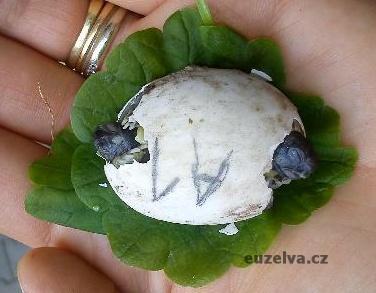
Hello Miloš. We are sending photos of our Hermann’s tortoise twins.
They shared a yolk sac and lay on their sides in a 69 position. I helped them hatch over 2 days as they showed no effort. After consulting a vet clinic, I tied off their sac with thread. It was a struggle navigating eight kicking little legs around a 1 cm sac full of life, which accidentally sustained a surface scratch from a claw. One twin started pulling the sac out of its belly unpleasantly.
After a stressful procedure and tying it securely, the babies spent 3 days in the terrarium and 3 nights in the incubator inside a shot glass, belly-to-belly to keep them calm. The sac daily shrank and changed color from orange to purple and dark red like a scab. On the 6th day, I snipped the dried cord connecting them. They had an incredible thirst and drank for a long time. They weighed only 6 g each and measured 2.5 cm – half the size of their peers!
Best regards, OVBP Černí
Update from owners (Jan 3, 2014):
"The turtles survived and are developing brilliantly! They are completely faultless and gorgeous. They grow incredibly fast – from 2.5 cm they reached 8.5 cm after a year and a half, and from 6 g they are now a respectable 120 g. They just finished short hibernation and will live outdoors in the enclosure from summer."
This case proves that nothing is ever lost in advance!

4. Two-Headed Tortoise (2015)
In July 2015, a tortoise hatched with a severe congenital defect – two heads. As of October 11, 2015, it is still alive, though its days are unfortunately numbered (99% incompatible with life). The tortoise cannot see, eat, or move coordinatedly. It survives solely thanks to the absorbed yolk sac, which acts as an energy reserve for about two months.
What is fascinating is that the rest of the body is completely normally developed – the shell and limbs were unaffected by the malformation. Our two-headed tortoise has both heads fused sideways, featuring four eyes and two beaks.
Among larger breeders, hatching such drastically deformed tortoises happens occasionally, though it shocks the general public. Nature never ceases to surprise. I hope its eventual departure from life is as painless as possible; when its time comes, I will assist it.


Related Articles in Our English Section:
Explore our other professional breeding guides:
- Testudo hermanni (Hermann’s Tortoise) Care Guide – Complete overview of keeping and breeding.
- Tortoise Incubators: Dry vs. Water-Based Systems – Learn how to build reliable hatching systems.
- Unhatched Tortoise Eggs: Candling and Identifying Bad Eggs – Practical inspection guide.
Copyright © euzelva.cz